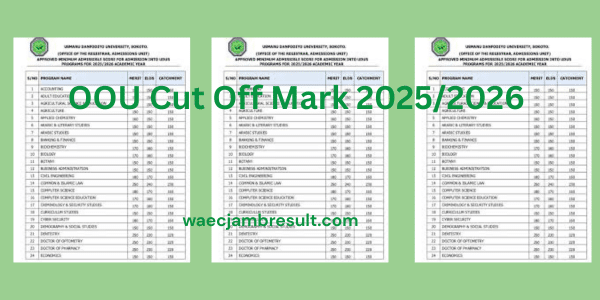
The Olabisi Onabanjo University cut off mark for the 2025/2026 admission cycle is a crucial number for thousands of applicants. Knowing the official threshold, how departmental cut-offs work, the documents you must prepare, and the steps that lead from application to formal admission will put you in the strongest position to win an offer. This guide explains everything clearly and simply so you can act with confidence.
The official general cut off mark for OOU for the 2025/2026 session is 160. Candidates who scored 160 or more in the 2025 UTME are eligible to apply for the OOU Post-UTME screening and be considered for admission into undergraduate programmes, provided they meet other academic and documentation requirements. This threshold is the baseline for screening, while departmental requirements may be higher depending on competition for each course.
The university has opened its Post-UTME application portal for the 2025/2026 session and published guidance about registration, deadlines and the screening process. Candidates are expected to complete the online application, pay the stipulated fee, upload required documents, and attend the screening either online or at the designated ICT centre when scheduled. Always use the official OOU Post-UTME portal when applying to avoid fraud and application errors.
Understanding what the cut off mark means and how selection is made will help you choose the right course, prepare the right documents, and maximize your chances during screening and final ranking.
What the cut off mark means for you
The cut off mark is the minimum UTME score the university requires to allow a candidate into its screening exercise. The 160 threshold at OOU is the pass mark for eligibility. Scoring 160 makes you eligible to register for the Post-UTME screening. It does not guarantee admission. Admission is determined by the combination of your UTME score, your Post-UTME screening score, your O’level results, and the overall competitiveness of the course you applied for.
Departmental cut-offs sit above the general threshold. Competitive programmes may set higher cut-offs, and final admission depends on available slots and how well applicants perform during screening. Always check the official departmental cut-off lists published by the university after screening because those lists show the minimum scores that secured admission for each programme in that admission cycle.
How OOU screens and ranks applicants
OOU uses a screening process that typically blends UTME results, Post-UTME performance, and O’level quality. The Post-UTME registration is completed on the university’s official portal and may involve a computer-based test or online verification. The screening result is combined with your UTME score and O’level grading to produce an aggregate score that determines ranking for each programme.
The Post-UTME registration window and the screening schedule are published on the official portal. Candidates must register within the stated window to be considered. In 2025 the portal for new applicants opened with clear instructions, and application deadlines were published there. Use the official portal as your single source of truth to avoid missing deadlines or using bogus third-party pages.
Who is eligible to apply
Any UTME candidate who scored at least 160 and selected OOU as a choice is eligible to apply for the Post-UTME. Candidates who did not choose OOU initially may still be able to change their first choice to OOU on the JAMB portal if the change window is open and before the Post-UTME registration starts.
Direct Entry applicants who hold acceptable qualifications such as A-Level, OND, HND or equivalent and who meet OOU’s departmental Direct Entry requirements are also eligible to apply. Direct Entry candidates must complete the DE application process through JAMB and follow any additional steps the university requires. Ensure your previous qualifications match the subject requirements for your intended course.
Documents you must prepare and upload
You must have clear electronic copies of your JAMB result slip, your O’level result(s) (WAEC, NECO, NABTEB), a valid means of identification, and any other documents requested by the portal such as birth certificate or sworn declaration of age. If you are applying by Direct Entry, you should also have scanned copies of your previous institution certificates or statements of result.
Make sure O’level results are properly uploaded on JAMB CAPS and that your data across JAMB and the OOU portal match exactly. Small mismatches in names, dates or other personal details can cause verification problems and delays. Confirm everything before submission and keep the application receipt or payment confirmation for future use.
How to pick the best course for your score
If your UTME score is slightly above the general cut off, pick courses that match your score range and the subject areas where you have strong O’level credits. Competitive professional and STEM courses often require higher aggregates. Choosing a course that is highly competitive with a marginal score reduces the chances of admission. If you scored well above the cut off, aim for the course you truly want and prepare intensively for the Post-UTME.
Research historical departmental cut-offs and performance data for guidance. Some unofficial sources publish course-level JAMB and Post-UTME thresholds for previous cycles, but always confirm with the official departmental list when the university releases it after screening. Historical lists can indicate realistic expectations and help you choose between ambition and strategy.
How to prepare for the Post-UTME and screening
Treat the Post-UTME as a decisive exam. Preparation should focus on the subject combination required for your course and on practice questions in the CBT format. Use past Post-UTME questions where available, practise time management, and ensure you are familiar with instructions and the exam software if the test is computer-based.
On the screening day follow all rules given in the admission notice. Arrive early, carry only permitted items, and have your identification and printouts ready. Malpractice or non-compliance with exam protocols will lead to immediate disqualification. The university publishes rules, venue details and timing on the portal, so read those instructions carefully and adhere to each requirement.
Also Read : JAMB DE (JAMB Direct Entry) Registration 2025/2026: Step-by-Step & Requirements
What happens after screening
After screening and scoring, candidates are ranked by department. The university publishes provisional admission lists once approvals are complete. Admission offers are reflected on JAMB CAPS, and candidates must accept or reject offers according to JAMB and university instructions.
If you receive an admission offer, accept it promptly on JAMB CAPS and complete any freshers’ registration steps set by OOU, which include payment of acceptance fee and submission of original documents at the designated registration center. Failure to accept and register within the stated deadlines may result in losing the offer. The university admission portal and JAMB CAPS are the official platforms for checking and accepting offers.
Common pitfalls that delay or disqualify applicants
Using unofficial portals or paying through unverified channels puts your application at risk. Uploading unclear documents, providing inconsistent personal details across platforms, missing Post-UTME registration windows, and engaging in malpractice during screening are common reasons for disqualification. Another frequent problem is failing to upload O’level results to JAMB CAPS before screening, which can prevent completion of Post-UTME registration.
Keep records of all your submissions and payments. If a problem arises, contact the university admission office directly and supply evidence of payment and registration. Do not rely on social media claims about cut-off marks or admission lists; always cross-check with the official university portal.
How to improve your admission chances
Improvement can come from careful course selection, stronger Post-UTME performance, and ensuring your O’level profile is in order. If your JAMB score is low relative to a competitive programme, consider alternatives such as related courses with lower demand or improving your qualifications through diploma or remedial programmes for future applications.
Networking with current students or alumni can give practical tips about acceptance scores and departmental expectations, but make decisions based on verified data. Keep an adaptable plan that includes backup courses and universities while aiming for your preferred programme. Staying calm, prepared and organized increases your chances of success.
Important deadlines and fees to watch
The university posts deadlines for Post-UTME registration on its portal and may extend them when necessary. Application fees and payment methods are listed on the portal and are typically processed through official payment gateways. Always pay through the university’s Remita or approved payment partners and keep receipts. Applying as soon as the portal opens avoids last-minute technical congestion and reduces stress.
If the portal shows a deadline extension, note the new closing date and complete registration early to avoid avoidable issues. Check the portal daily during registration windows so you never miss updates or changes to the schedule.
Where to verify official information
The official OOU Post-UTME portal and the university admissions pages are the definitive sources for forms, deadlines, screening schedules and admission lists. JAMB CAPS is the official platform for admission offers and acceptance. Reputable education news sites and university-focused portals often reproduce official announcements, but they should only be used to confirm details when the official source is slow or inaccessible. If anything in the news or social media conflicts with the portal notices, always trust the official university page and JAMB CAPS.
Checklist of what to do now
Confirm your UTME score and that OOU is in your JAMB profile. Register on the official OOU Post-UTME portal as soon as registration opens and pay the required fee through the official payment gateway. Upload all required documents clearly and double-check that your O’level results are properly reflected on JAMB CAPS. Prepare for the Post-UTME by practising CBT questions and timing.
On the day of screening follow exam instructions, guard your credentials, and avoid prohibited items. After screening monitor the OOU portal and JAMB CAPS for admission lists, accept any offer quickly, and follow the university registration instructions for fresh students. Keep all receipts and confirmations until the admission and registration process is complete.
Final advice
Clear, verified information and disciplined preparation are your best tools. The OOU general cut off mark of 160 is the gate to screening. Departmental cut-offs and final admission decisions depend on competition and scores achieved during screening. Use the official portal for all applications and verify any news with the university’s admission pages or JAMB CAPS. If you want, add FAQ and Article schema to the published page to boost visibility in search results and increase click-through rate.
Recommended Article : Requirements for Studying Medicine in Nigeria 2025/2026: Step-by-Step Guide to Admission
Frequently Asked Questions (FAQs)
1. What is the official OOU cut off mark for 2025/2026?
The general JAMB cut off mark for Olabisi Onabanjo University (OOU) for the 2025/2026 academic session is 160. Candidates who scored 160 or above in UTME can apply for the Post-UTME screening exercise.
2. Does scoring 160 guarantee admission into OOU?
No, scoring 160 only makes you eligible for screening. Admission is based on your UTME score, Post-UTME performance, O’level results, and the departmental cut-off for your chosen course.
3. What are the departmental cut off marks for OOU?
Departmental cut off marks vary depending on each course’s demand and competitiveness. For example, Medicine, Law, and Engineering often have higher cut-offs, while less competitive courses may have slightly lower thresholds. The official departmental list will be published after screening.
4. Can I apply to OOU if I didn’t choose it in my JAMB form?
Yes, you can. Simply apply for a change of institution on the JAMB portal and make OOU your first choice before registering for the Post-UTME screening.
5. What is the OOU Post-UTME screening process like?
OOU conducts an online or CBT screening for eligible candidates. The process includes online registration, document uploads, and either a test or result verification. The final aggregate score determines admission chances.
6. How can I check if I’ve been admitted to OOU?
You can check your admission status through the OOU admission portal and the JAMB CAPS platform. Always accept your admission on JAMB CAPS before proceeding with registration at the university.
7. What documents are required for OOU Post-UTME registration?
Candidates must upload their JAMB result slip, O’level results (WAEC, NECO, or NABTEB), birth certificate or affidavit, and a valid identification card. Direct Entry candidates should include their previous qualification certificates.
8. When will OOU Post-UTME registration for 2025/2026 begin?
The university will announce the official registration dates on its Post-UTME portal. It’s advisable to check frequently to avoid missing the deadline, as late registration is usually not accepted.
9. What are the admission requirements for Direct Entry candidates?
Direct Entry applicants must possess at least two A-Level passes or relevant ND, HND, or NCE certificates in related fields and must also meet the O’level subject requirements for their chosen course.
10. How can I improve my chances of gaining admission into OOU?
Prepare thoroughly for the Post-UTME, ensure your O’level results are strong and properly uploaded on JAMB CAPS, and apply for a course that matches your UTME score range. Always use official university channels to avoid mistakes or scams.
11. Can I combine two O’level results when applying to OOU?
Yes, OOU allows the combination of two O’level results (such as WAEC and NECO), provided both are obtained in not more than two sittings and meet the subject requirements for your chosen programme.
12. How much is the OOU Post-UTME application fee?
The Post-UTME registration fee is usually around ₦2,000, payable only through the official OOU portal using approved payment channels. Always keep your payment receipt for verification.
13. What happens if I miss the OOU Post-UTME screening date?
Missing your screening schedule can affect your admission chances. Always confirm your screening date on the portal and arrive early. In rare cases, the university may allow rescheduling, but this is not guaranteed.
14. Is OOU accepting candidates for second choice in 2025/2026?
Typically, OOU does not consider second-choice candidates. Applicants are strongly advised to make OOU their first choice institution when registering or updating their JAMB details.
15. How can I contact OOU for admission enquiries?
You can reach the OOU Admissions Office through the contact details on the official university website:
👉 https://oouagoiwoye.edu.ng.
Avoid unofficial agents or social media handles claiming to represent the university.